Originally published at: We've released data on half a million attempted repairs - The Restart Project
As part of our International Repair Day celebrations this year, we are thrilled to release the latest Open Repair Alliance (ORA) dataset – our vast open dataset of information on items and repairs seen at community repair events around the world.
Just like the community repair movement itself, the volume and value of the data has grown again in 2026. The ORA dataset now represents a remarkable log of over half a million records of repair attempts from the community repair movement. Every single row of data represents multiple people working together in their community to fix their broken things.
Since we started collecting this data, there are now:
 619,873 repair attempts logged
 From 41,110 events
 Held by 1,728 repair groups
 In 34 countries worldwide
Why collect repair data?
At our most recent Repair Day event in London, one participant brought along a broken bedside lamp. The plastic part that held the bulb had broken, and as we tried to take it apart, she was shocked to learn that there was no way to replace this part without cutting the lamp in two.
It’s an open secret that many products simply aren’t designed to be fixed. Like many products, this lamp couldn’t be taken apart without breaking it further. But from the price of spare parts to lack of software support, there are lots of different barriers preventing us keeping things working for longer.
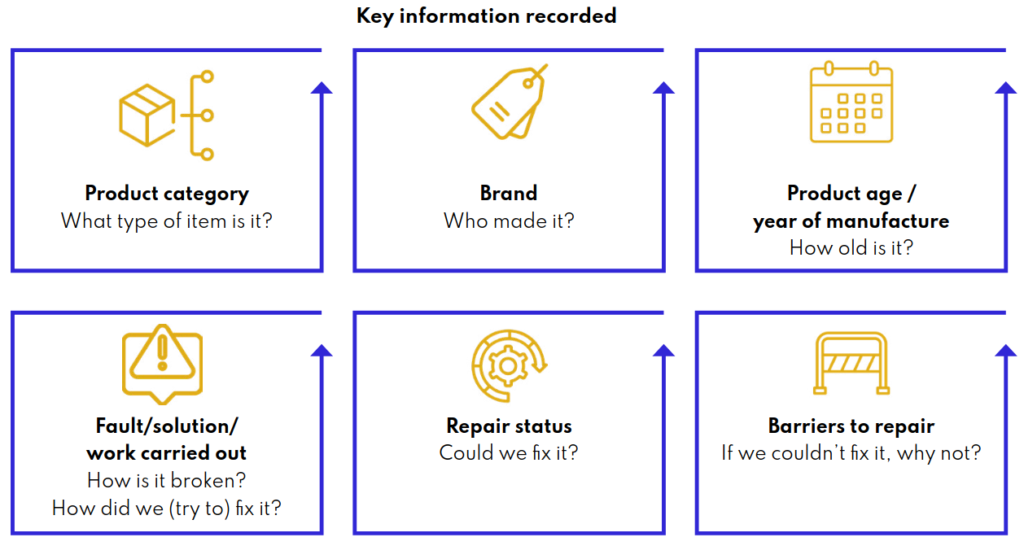
To address this challenge, we need to understand it better. So back in 2017, Restart co-founded the Open Repair Alliance. Our main aim was to make it easier to learn why products break and how they could be made easier to fix. To do this, we developed a standard for recording information about the repairs attempted at community repair events. And to make it easier to gather all of this information together, we also created tools community groups can use to log this data.
Every year since, we’ve pulled all this data together, cleaned it up and published under an open license for anyone to download.
And all kinds of organisations have used it. Public bodies, researchers, companies and campaigners all use it to better understand the barriers to fixing more products, helping make the case for the Right to Repair.

Where does the data come from?
The data in the Open Repair Alliance dataset is collected by volunteers in community repair organisations all over the world. People run community events like Restart Parties, Repair Cafes and Fixit Clinics, where they help people from their community fix their broken items.
Many groups then log the data about the items they saw at their event, digitally on an online platform, such as Restarters.net. Then, on behalf of our partners in the Alliance, Restart combines these together into one dataset.
Dive into the data
There’s a lot of information in the Open Repair Alliance dataset, and it has been used in a variety of ways. Read the official ORA announcement for more detail about the new dataset. Or view a highlight of the published reports and analyses on ORA’s Insights page and explore the latest data in an interactive overview.
Want to dive even deeper?
You can download the data for yourself. Or if you’re involved in a community repair group and would like to contribute repair data from your own events, you can do so with our community platform, restarters.net or one of the other tools listed here.

