I am wanting to replace a battery inside a Bosch Readyy’y Vacuum cleaner. Bosch will not supply. new battery only a new chassis (motor and battery unit), sold for the price of a new vacuum cleaner. Anyone able to give me some guidance about what battery to get / what tools I might need or if someone can help me do it?
What’s the exact model number?
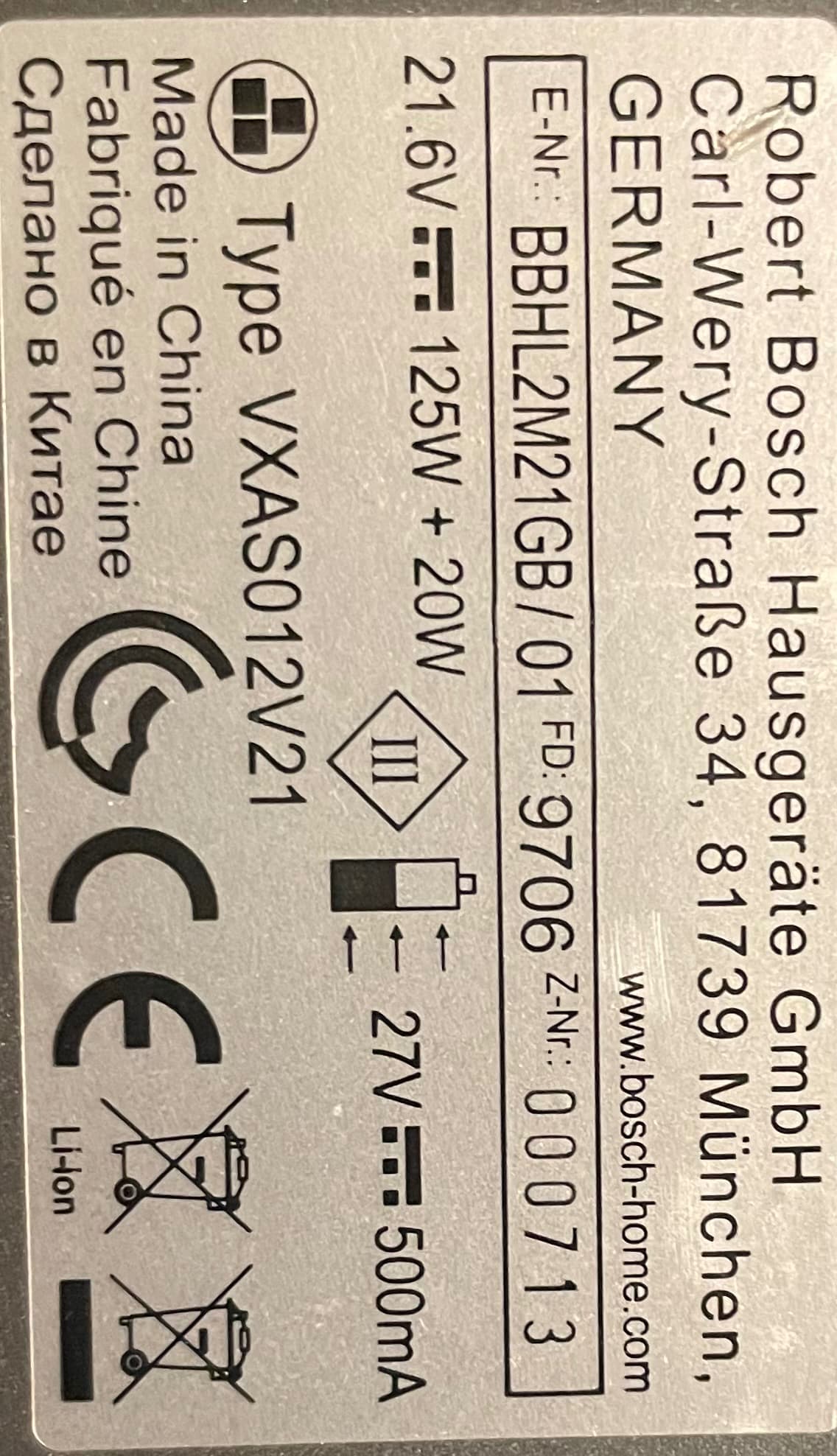
Thanks for responding Ian,
I believe it’s a Bosch Readyy’y series1 although not written anywhere on the cleaner
On some items, once the battery get below a certain voltage, the circuit does not have the power to power the BMS. On other systems the BMS locks the battery out.
If yours is the first type, slowly charge via constant current by 0.1A (0.1C) from 0v to about 3.3-ish V. From this point onward the charger should be able to take over.
From 3V to 4.1v charge at 1C, so I usually choose 1A. You could user a 4V psu with 47ohm in series to limit current too
Ideally you spotweld the cells which imparts a short duration instant heat. Soldering, due to prolonged high temp may cause a gas bubble to be created between the battery and casing, reducing the capacity.
If your battery is the second type, replacing the cells will not help you, as the electronics will have locked it out
Think this is the process
https://www.youtube.com/shorts/78xnay6-UbA
If you want a rough test for battery condition, you can use a capacitor in series to a esr meter to roughly guage the internal resistance of the battery. A quick search on YT should reveal the methodology
2 Likes
We occasionally rebuild packs if we have to… not easy or risk free…
If you can, monitor the first charge and discharge using a thermal camera to spot any poor connections, before you put it back together.
Having looked at Ken’s video links I can certainly get replacement cells but have no spot welding equipment / experience (lithium batteries and all that) Is there anyone in the community who is appropriately equipped?
Thanks for the guidance
We’ve got a small spot welder and nickel strips etc…
Possibly not convenient for you as we’re in Sheffield but you are cordially invited to visit and use it!
G
1 Like
If you get cells with tags on you can easily solder them. (I often take such cells from old battery packs after first testing them).
I have soldered cells without tags and never had a problem. The trick is to keep the heating quick which means emory papering the surfaces, apply flux , using a faily big soldering iron. Then whetting each surface should only take one or two seconds.
Or if the mood takes you you can make a suitable spot welder from an old micriwave oven (very simply), instructions on youtube. But you will have to buy some nickel strip since you can’t use copper wire for the welding method.