Niko Paech: Repair in the post-growth economy
Niko argued that there is no such thing as green growth; infinite, sustainable growth is not possible, which means that we need to start thinking about what a post-growth economy looks like.
Reaching full employment is getting harder
He said that as labour becomes more productive (thanks largely to technology), the minimum level of growth to achieve full employment increases. He demonstrated this with the following graph:
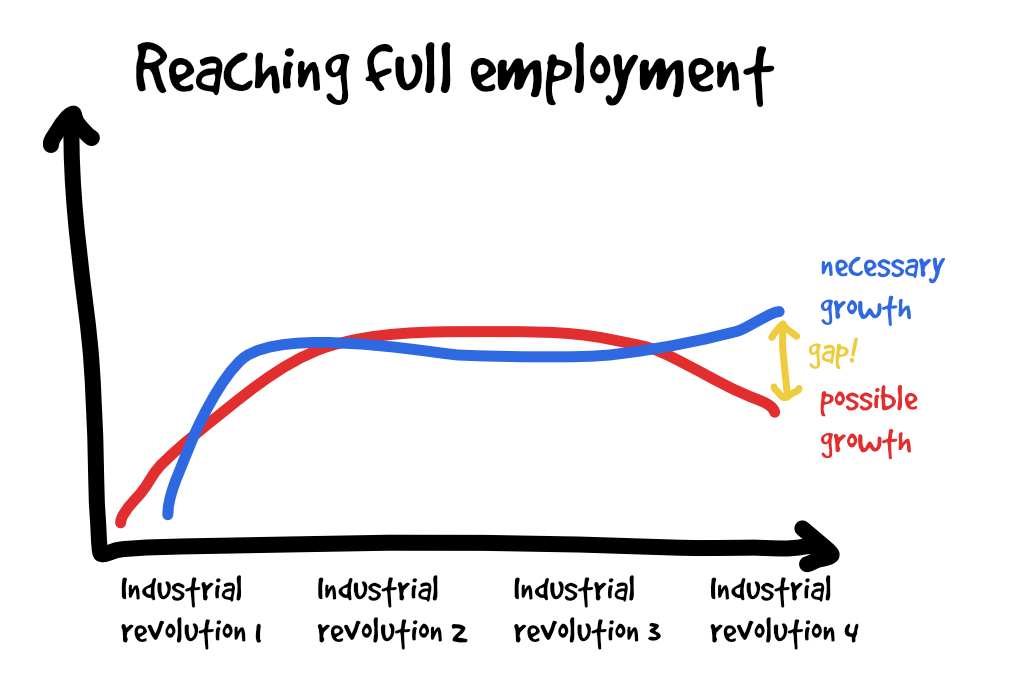
^ This graph is a rough sketch of the version used in the original presentation. It shows that as we move into the 4th industrial revolution, the gap between the growth needed for full employment and growth actually possible is widening) more than ever before.
Niko used this graph to argue that we need less growth-dependent production systems to address this gap.
No such thing as green growth
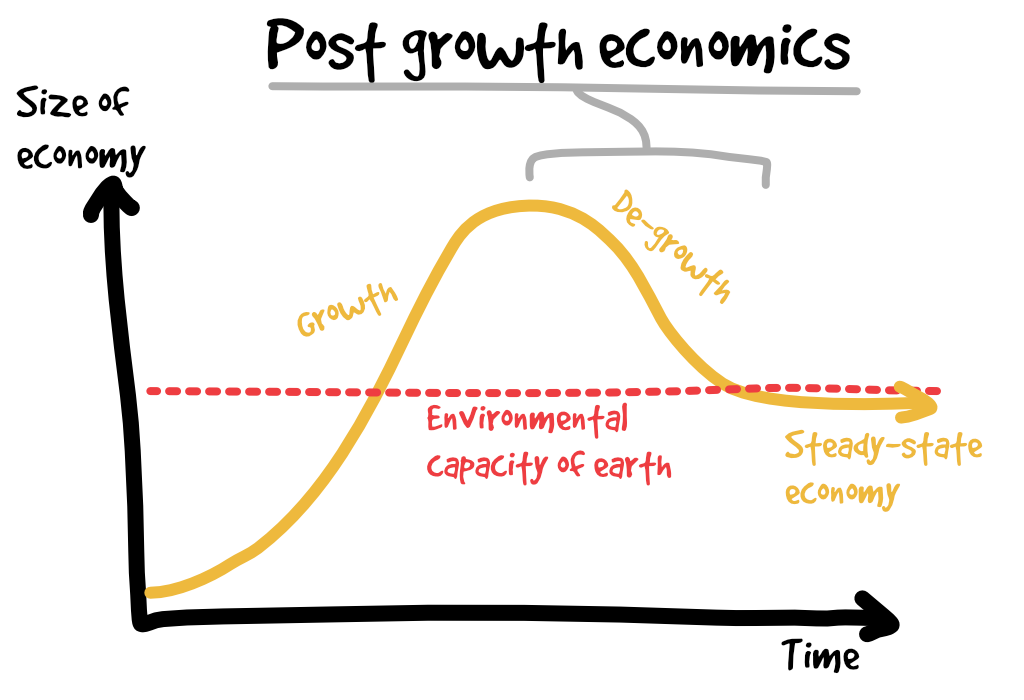
Niko introduced the field of post-growth economics; a number of disciplines including growth criticism, growth drivers, post-growth economy theory and others. The aim of is to work out how to transition from a paradigm of infinite growth to a zero-growth or ‘steady-state’ economy that is in line with the environmental capacity of the earth, as illustrated by this graph:
Achieving a post-growth economy
He put forward a number of ideas for how to achieve this, including:
- substituting industrialised supply chains with more labour
- turning ‘consumers’ into ‘prosumers’ by reducing the average working week to 20 hours and using our spare time to create decentralised networks for maintaining, repairing and producing things. This could replace traditional manufacturing to an extent.
When answering the question ‘how can we make this happen’, Niko suggested that we all have a responsibility/opportunity to make it happen by choosing to life alternative lifestyles, work fewer hours and focus on ‘prosuming’ (repairing, producing, maintaining). He argued that if enough people do this, the idea would spread via social diffusion.
@Marie_Lefebvre notes
The main agenda for the presentation was growth and sustainability, history and perspective of post growth, production theory, suply chain management and the role of prosumers in contributing to post growth.
Niko Paech asked us ‘‘where welfare comes from?’’ and continued ‘’ from higher labour, higher GDP, from work to produce more items, services, values, the tendency is just to produce more and more’‘. A question that need to be addressed is ‘’ How can we achieve social stabilisation while we do growth (with the full awareness of its social and environmental impacts)?’’ Shall we change the theory of grozth? How do to it:
- We need to beco,e independent of specialisation, indepedent of technology, independent of system of demand and supply.
Niko Paech share the history and development of the literature about growth and degrowth from the 18-19th Century til today. At different point, authors had different questions of interests
18-19th Century: Is unlimited growth possible?
1911_1967 : Does Growth increase welfare?
1971_1983: Is growth ecologically harmful?
1988-: is Degrowth possible?
The field of degrowth has three components: growth cristicism; growth drivers and post growth economics.
Niko Paech then went through the history of supply chain managment and ask the question: What is the future of supply chain management? He shared the three dimensiobs of suply chain management
- Commercial, Global with long supply chain
- Commercial, Regional with medium supply chain
- Non Commercial, local and self supply
The future of supply chain management shall reduce the the commercial global supply chain in favour of more local and regional models. How to achieve this. We need to ask ourselves how do integrate citizens (consumers) in reducing the use of commercial global supply chain. Niko Paech indicates that the main way is to reduce the number we work to approximately 20 hours a week. It will support a redefinition of the relationship between citizens (prosumers) and companies.
Niko Paech share the importance of educating people about time and providing time substitutes as well as to create some part-time model to absorb output reduction.
To add notes, click on the ‘Edit’ button, bottom right

